


By Maxime Duzyk, Director of Building Science and Engineering at Huntsman Building Solutions
Western Canada’s construction landscape is a complex one. The confluence of various factors, such as geographical, climatic, and structural conditions, all create a collision of tight timelines and high-performance demands. Here, insulation, particularly spray polyurethane foam (SPF) insulation, emerges as a strategic and all-around problem solver.
Going beyond its thermal insulation capabilities and R-value, SPF has unique properties that address many builders’ most persistent challenges: irregular framing cavities, hybrid assemblies, air barrier continuity, historic retrofits, and thermal bridging, just to name a few. Whether it’s new construction or retrofit, residential or commercial, SPF provides the flexibility to meet design intent without compromising buildability.
Irregular framing and unforgiving geometry
Job sites are rarely perfect: things like framing may be out of square, cavities might not be of standard depth, and retrofits often reveal unexpected conditions hiding behind drywall or brick. For batt and board insulation, this kind of inconsistency can lead to voids, gaps, and thermal short-circuits even in otherwise thoughtful assemblies.
Spray foam’s ability to conform to irregular shapes and expand into tight, complex areas makes it a clear fit for these kinds of scenarios. Unlike rigid insulation, SPF molds itself to the substrate, filling corners and contours to deliver a seamless, high-performance thermal and air barrier. This ensures that even in the most challenging spaces, the envelope performs as intended.
Imagine a mid-rise apartment retrofit built in the 1970s. After decades of shifting, settling, and renovations, no two wall cavities are the same. Stud spacing is inconsistent, and some bays are warped or partially obstructed. For rigid insulation, this would mean extensive reframing or custom cutting, both time-consuming and expensive. But with spray foam, the material conforms to every surface, expanding to fill gaps, corners, and odd geometries, ensuring a consistent thermal and air barrier without added labor. The result is not only improved efficiency but also reduced material waste and installation time.

Hybrid wall assemblies and material transitions
Modern buildings are increasingly complex, often combining steel and wood, masonry and sheathing, new and old. These hybrid assemblies can create significant discontinuities in the thermal and air control layers, especially at junctions or interfaces where one material ends and another begins. These junctions can become weak points if not properly sealed and insulated.
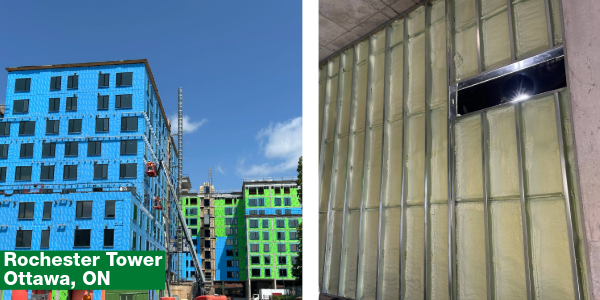
SPF’s self-adhering nature and compatibility with a wide range of substrates make it uniquely suited to span these transitions. Whether bridging between steel studs and concrete block or transitioning from concrete blocks to structural wood sheathing, spray foam helps maintain continuity in a way that few other materials can. It eliminates the need for multiple products and reduces detailing complexity, which can improve both performance and constructability.
Picture a municipality where a new wood-framed gymnasium addition is being connected to an older concrete block structure. The intersection between old and new materials is a hotspot for thermal bridging and air leakage. Applying spray foam across both assemblies provides continuous insulation and seals the junctions in one step. No need to switch or compromise performance; it’s a single, adaptable material bridging multiple substrates. This continuity simplifies design, speeds up installation, and helps futureproof the building envelope.
Accelerated timelines and compressed schedules
Time is money, especially when it comes to the building envelope. In high-pressure builds, delays in achieving a weather-tight enclosure can ripple through the project timeline, jeopardizing not just occupancy deadlines but the critical path of all trades that follow. As labour shortages continue to affect the industry, speed and sequencing are more important than ever.
Spray foam’s dual-role function as both insulation and air/vapour barrier reduces the number of steps needed to close in a building. Its rapid curing time means cladding or drywall can often be installed the very next day. And its single-application performance minimizes coordination across multiple trades. This allows crews to move quickly without sacrificing quality or performance.
Consider a commercial project that’s fallen behind schedule due to supply chain delays. With winter approaching, the team needs to enclose the building fast to keep trades moving inside. Rather than waiting on multiple subcontractors for batt insulation, vapour barrier, and air sealing, spray foam insulation is applied in a single mobilization. The next day, drywall goes up – and the job is back on track, without sacrificing envelope performance. In many cases, this streamlined approach also reduces staging and equipment needs on-site.

Heritage and retrofit applications
Historic buildings come with unique insulation challenges, not just because of irregular structure but because of material sensitivity, ventilation concerns, and the need to preserve character-defining elements. Traditional insulation methods often fall short, either failing to meet modern energy performance targets or requiring invasive alterations to the building fabric. Retrofitting these structures demands both technical precision and architectural sensitivity.
Closed-cell SPF, with its ability to insulate without the need for additional framing or venting, is increasingly being used in heritage retrofits where space is limited and minimal disruption is critical. Its high R-value per inch means it can deliver required performance in narrow wall or roof assemblies, preserving internal floor space and exterior architectural features. SPF also reduces air infiltration, helping to improve occupant comfort in older, draft-prone buildings.
Now think of a century-old school building slated for an energy retrofit. The exterior masonry can’t be altered, and interior space is tight. Traditional insulation methods either won’t fit or risk trapping moisture. Spray foam offers a high R-value per inch and can be applied directly to the interior face of masonry, improving thermal performance while maintaining the building’s character and minimizing space loss. Because it acts as an air and vapour barrier, it also helps protect the historic structure from moisture-related damage over time.
Climate expenses and durability demands
Across Western Canada, buildings must contend with a wide range of environmental conditions: frigid winters in the prairies, coastal moisture on the west coast, and freeze-thaw cycles that put even the most resilient envelopes to the test. In these conditions, insulation isn’t just about keeping warm – it’s about managing condensation, resisting water intrusion, and maintaining performance over time. Durable envelopes are essential for long-term energy savings and building longevity.
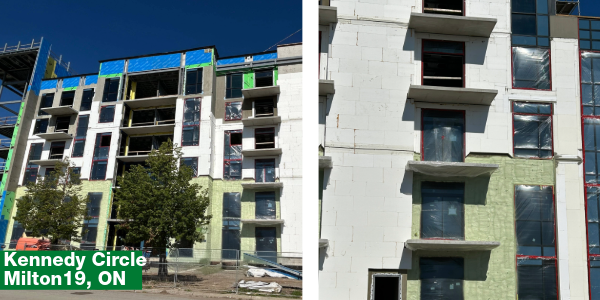
Closed-cell SPF excels in extreme conditions thanks to its low permeability, structural rigidity, and resistance to moisture intrusion. It also contributes to the overall durability of the wall assembly by adding racking strength and helping prevent air leakage that can drive condensation inside the envelope. These qualities make it especially valuable in buildings exposed to high winds, high humidity, or rapid temperature swings.
Imagine designing for a mountain lodge in an alpine region, where temperatures regularly dip below -20°C. The building needs to withstand snow loads, high winds, and daily freeze-thaw cycles. Closed-cell spray foam provides both insulation and structural enhancement, forming a continuous envelope that resists air and moisture infiltration even under extreme conditions – keeping the interior comfortable and reducing heating demands year-round. Over time, the energy savings can be substantial, contributing to a lower carbon footprint.
Performance meets practicality
While the industry often talks about R-values and building codes, the real test of insulation is how it performs on the job site, such as under pressure, in real-world conditions, and alongside dozens of other moving pieces. Spray foam insulation shines because it simplifies the complex. It adapts where others require workarounds. And it delivers performance without adding steps, products, or delays.
As the demands on building envelopes grow, from higher energy codes to decarbonization targets, flexible, high-performance materials like SPF are becoming not just helpful, but essential. The projects that succeed tomorrow will be the ones that solve problems today. And increasingly, spray foam is part of that solution. Whether it’s part of a deep retrofit strategy or a new build optimized for net-zero, spray foam is proving its worth where it matters most: in the field.

About Maxime Duzyk
Maxime Duzyk is the senior global director of building science and engineering at Huntsman Building Solutions. He holds a background in architecture and has been in the sprayfoam insulation business for the last 15 years. Duzyk is involved with different building envelope committees and associations in North America such as CSC, SFC, SPFA, CCMC, and ULC Standards.

About Huntsman Building Solutions
The Huntsman Building Solutions business is a global leader in high-performance, sustainable building envelope solutions. Its systems and solutions are widely utilized to optimize commercial and residential structures worldwide in both new construction and retrofit applications. Formed in 2020 with the acquisition of Icynene-Lapolla and its combination with Demilec, the Huntsman Building Solutions business capitalizes on legacy industry technologies, environmental stewardship, and the power of the Huntsman brand.
For more information, visit huntsmanbuildingsolutions.com.
Leave a Reply