


By Alexander Michalatos, Co-Founder & CEO, Buildcheck
I was born in the Lower Mainland to a construction family. My father, a Greek immigrant, built single-family homes across Richmond and Vancouver. Growing up, construction wasn’t just an industry; it was the industry. In British Columbia, real estate felt like the ultimate career: projects got bigger, towers climbed higher, and rents seemed to rise without end.
Today, the picture looks different.
After decades of limited supply and strong global demand, Vancouver became one of the least affordable cities in North America. Governments responded with demand-suppression measures (foreign buyer taxes, empty homes taxes, etc.) while broader macroeconomic forces tightened their grip. Interest rates climbed. Material costs spiked. Supply chains fractured. Tariff uncertainty added even more pressure.
All of that has made work harder to win. Margins are tighter. Risk is higher.
For large general contractors, that has meant pivoting toward public infrastructure like hospitals, airports, and community facilities: projects with large budgets and even larger risk profiles. Delivery models have shifted toward design-build and alliance contracts, placing greater design responsibility on contractors.
In the mid-market, competition is fierce. Projects that move forward attract dozens of bidders. Owners are more sophisticated than ever and often engage contractors early through preconstruction services or GMP structures. They aren’t just looking for the lowest price; they’re looking for the best partner.
Layer on Canada’s persistent productivity challenges and widening labour gap, and it’s fair to say the industry is navigating one of its more complex cycles.
And into that environment comes a bold promise: Artificial Intelligence (AI).
Cutting through the AI hype
When we speak to contractors, the question we hear most often is: “What can AI actually do?”
It’s a fair question for contractors considering using their hard-won margin on tech.
The AI companies dominating headlines like OpenAI, Anthropic, and Google have trained large language models (LLMs). As the name suggests, these models are excellent at language. That means they perform well in text-heavy workflows: contract review, document summarization, information retrieval.
That’s useful. But as any GC knows, our industry doesn’t run on text. It runs on drawings.
Until a machine can interpret the black lines on a sheet – distinguishing walls from dimensions, callouts from gridlines, mechanical equipment from lighting fixtures – AI remains peripheral to real construction risk.
At Buildcheck, we’ve spent the past two years developing proprietary computer vision models specifically trained to read construction drawings.
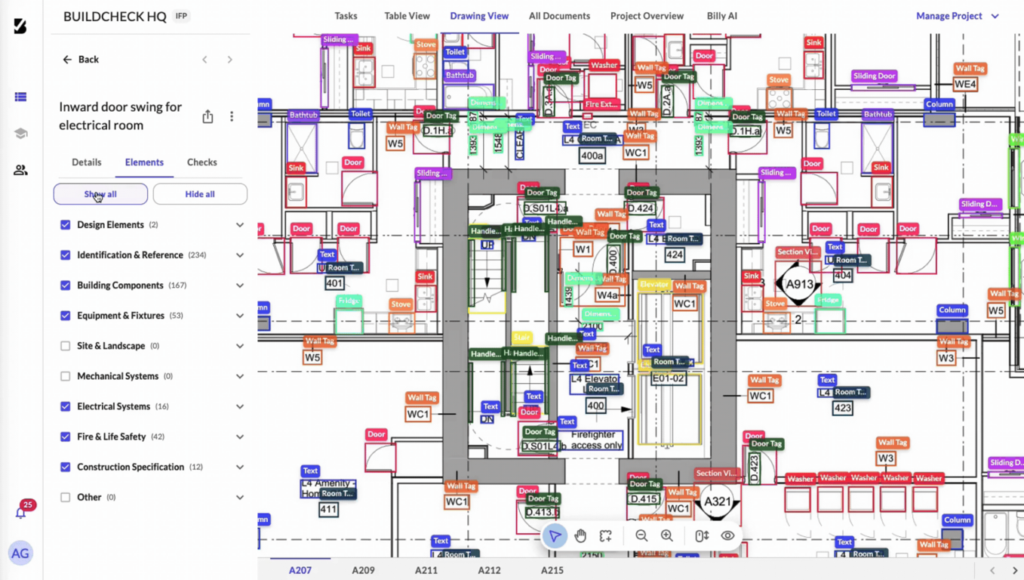
This isn’t generic AI. It requires thousands of labeled architectural, structural, and MEP drawings, deep domain expertise, significant computational infrastructure, and continuous refinement across real projects.
Drawings are not standardized. Symbol sets vary. Layering conventions change. Discipline coordination is inconsistent. That complexity is exactly why automated drawing analysis is difficult and why it’s valuable when done well.
Computer vision on drawings unlocks workflows across the lifecycle:
- Automated design reviews
- Shop drawing cross-checks
- Change order quantification
- Preconstruction risk analysis
- Automated take-offs
But we knew we had to start somewhere specific. So, we focused on one of construction’s most persistent pain points: design errors.
The $200 billion problem: Design errors
Globally, design errors and coordination gaps cost the industry over $200 billion annually. In Western Canada, where contractors are increasingly assuming design risk, that exposure is only growing.
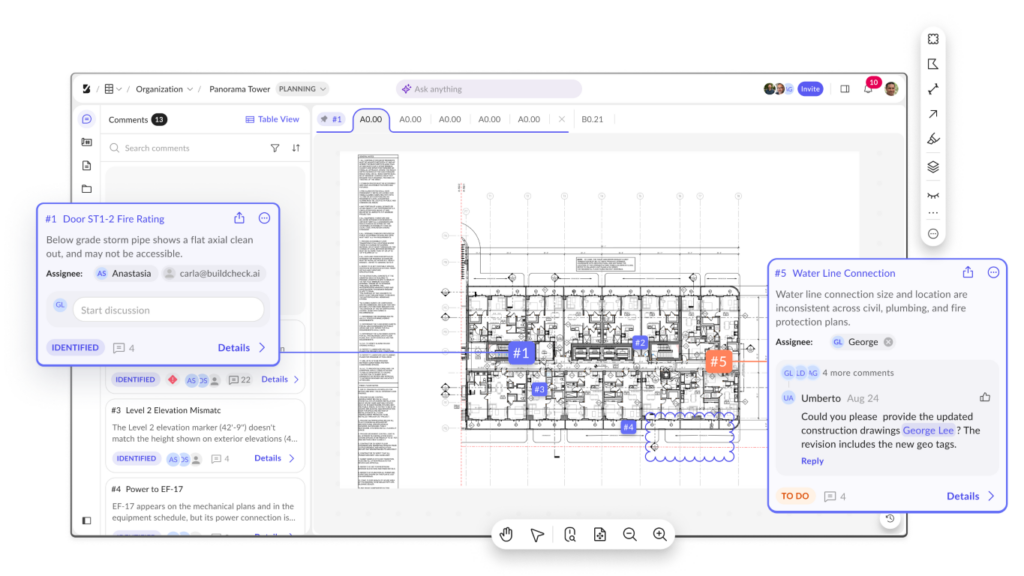
Incomplete drawings. Conflicting fire ratings between disciplines. Missing dimensions. Undersized power to mechanical equipment. Inconsistent specifications. Every one of these issues can lead to RFIs, change orders, schedule delays, or strained owner relationships.
Buildcheck performs over 300 checks across drawing sets. Some are straightforward – missing wall tags or inconsistent door numbering. Others are more complex – cross-discipline fire-rating mismatches or electrical capacity conflicts.
In December 2025, we announced a $5.9 million financing round to expand our technology and team. Our clients include EllisDon, Cressey Development Group, and HCMA, among others, in Western Canada.
Primex Investments, a multifamily builder in British Columbia, used Buildcheck on a 230-unit, multi-building project. The result was $500,000+ in cost savings and 27 days saved on schedule.
Jared Krish, Director of Development at Primex, put it this way, “With a project of this complexity spanning multiple buildings and numerous MEP systems, we needed absolute confidence in our drawings. Every coordination issue that Buildcheck caught saved us from expensive field modifications and potential delays that could have impacted our delivery schedule.”
In a market where every margin point matters, those numbers are meaningful.
Why this matters now in western Canada
Western Canadian contractors are increasingly managers of risk – contract risk, operational risk, and design risk.
The best firms don’t just build well. They identify risk earlier than their competitors.
In today’s environment:
- Public-sector design-build contracts push more design responsibility downstream.
- Mid-market developers expect contractors to add value in preconstruction.
- Competition demands sharper bids with fewer unknowns.
AI-powered design review directly supports those pressures. It strengthens preconstruction, improves bid confidence, and reduces downstream surprises.
And importantly, it’s practical today.
The road ahead
Let’s be clear: AI will not replace your superintendent. It won’t negotiate a subcontract. It won’t sequence concrete pours in winter. It won’t manage site logistics or lead a toolbox talk.
Construction leadership, execution, and judgment will remain deeply human.
What AI can do is remove the repetitive, pattern-based review work that consumes hours of preconstruction effort and reduce the likelihood that small oversights turn into expensive field problems.
Computer vision on drawings will continue to improve. With it, we see future applications expanding from error detection toward proactive design improvement:
- Automated building code compliance checks
- Specification-based rule validation
- Design optimization and value engineering suggestions
- Real-time coordination feedback as drawings evolve
Is AI overhyped? Often, yes. Does it have a more useful application in construction today than most realize? Also, yes. But it’s easy to debate AI in a jobsite trailer. It’s harder, but more productive to test it. General contractors are beginning to understand that, with some surveys showing up to 64 per cent of organizations experimenting with AI.
Western Canada’s construction market is competitive. Contractors who manage design risk better than their peers will win more work and protect more margin.
AI is finally reaching a point where it can analyze drawings and begin to do some of that work.

About Alexander Michalatos
Alexander Michalatos is the Co-founder & CEO of Buildcheck. A Vancouver native, he worked at Stantec as an industrial designer for P3 projects across the country. He then worked as a project manager at Honeywell, a M&E Manager at EllisDon on hospital design-builds, and a real estate developer on mixed-use residential projects at QuadReal before founding Buildcheck.
He graduated with a degree in mechanical engineering from the University of British Columbia and attended Stanford University for his MBA under a Canadian Fulbright scholarship.

About Buildcheck
Buildcheck is a collaborative design review platform that is teaching AI to understand drawings, the language of construction. They work with real estate developers and general contractors, screening plans to catch issues before they become change orders, RFIs or city comments. Industry leaders like AvalonBay Communities, EllisDon and Dempsey Construction use Buildcheck to realize a 10x to 40x ROI. See more at www.buildcheck.ai.
Leave a Reply